I'm not here to fix you.
I'm here to walk alongside you.
Twenty years in the Navy taught me how to show up for people in the hardest moments of their lives. That's still what I do. The container just changed.
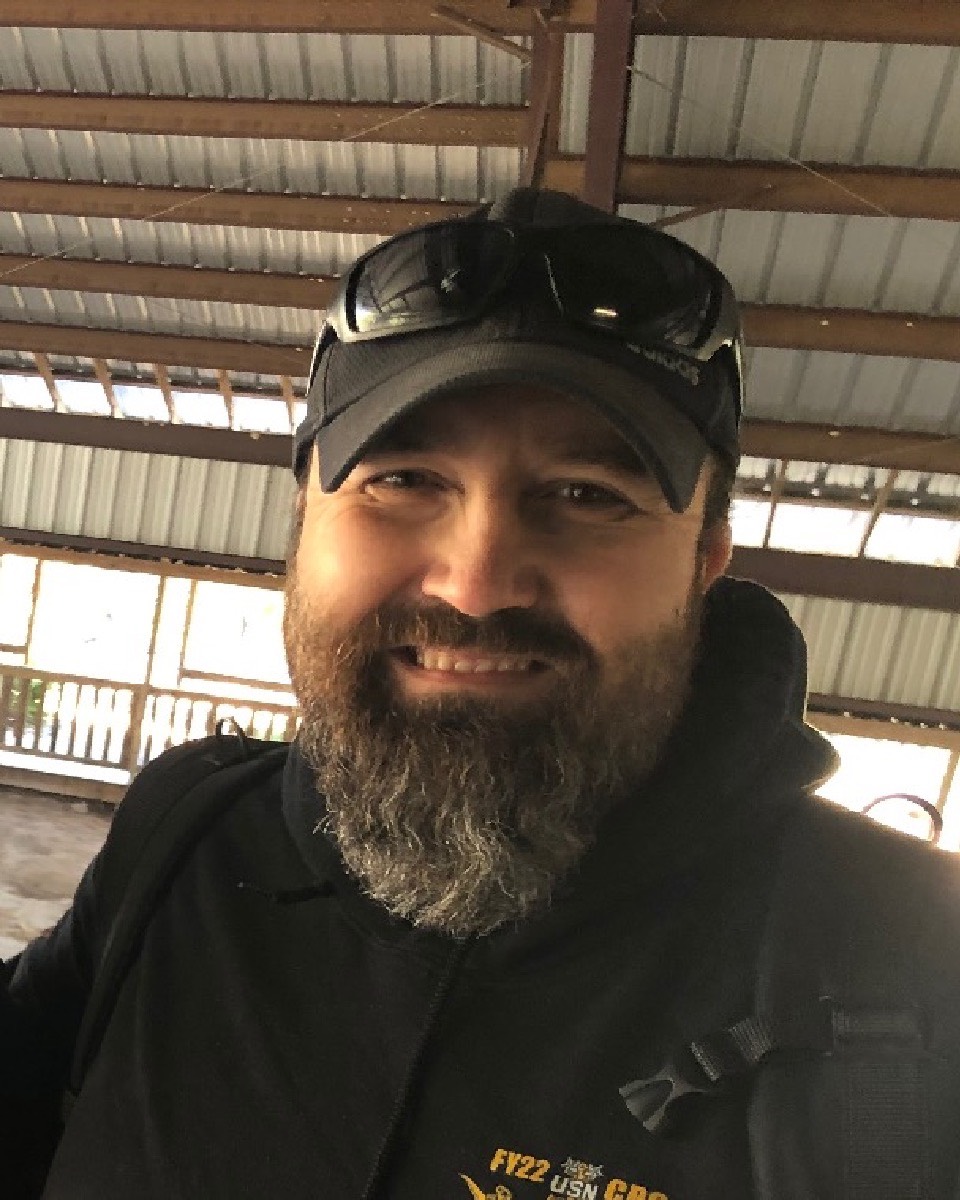
Chris — Navy veteran, coach, husband, father.
The uniform came off.
The calling didn't.
I spent twenty years as a Navy Corpsman. My job was to show up — fully, completely — for the person in front of me. Triage. Stabilize. Get them back on their feet. Not because it was a job description, but because the person next to me was counting on it.
When I retired, I carried those instincts with me. And I started noticing something in the people around me — veterans, military spouses, people navigating the years after service — who were doing everything right and still feeling completely lost.
Not in crisis. Not broken. Just displaced. Like someone had quietly moved the goalposts and nobody told them.
That's not a clinical problem. That's a container problem. And nobody was really talking about it.
So I went and got the training to help with it. Not just the clinical side — though I got that too — but the whole person. Brain science, psychology, mindfulness, faith. Everything that helps someone find their footing again when the ground has shifted.
That's what The Bearded Coach is. One person, walking alongside another. Doing the hard work. Not alone.
Four tools. One person. No jargon.
This isn't one modality bolted onto a coaching framework. It's four disciplines working together — each one translating what the others can't fully explain on their own.
Brain Science
Your nervous system adapted to survive. That's not weakness — that's engineering. Understanding how the brain works under stress, in transition, and in recovery changes what becomes possible.
Psychology
The patterns you're living in were learned somewhere. Some of them served you well. Some of them have outlived their purpose. We look at both — without diagnosing, without labeling, without pressure.
Mindfulness
Not meditation apps. Not breathing exercises for their own sake. Presence — the ability to be here, in this moment, with this person, doing this work. It's a skill. We build it.
Faith
Not as a pressure tactic. Not as a requirement. As a lens — one that sees people as made for something, carrying inherent worth, capable of restoration. It shows up in how I see you, not in what I demand of you.
It shows up in how I see people.
Not in what I require of them.
I'm a person of faith. That shapes everything about how I do this work — how I see the people I work with, how I understand purpose and identity, how I sit with hard things without flinching.
But faith here is not a program requirement. It's not a prerequisite. You don't have to share my beliefs to benefit from this work. You just have to be willing to do it.
I believe every person is made for something. That the things you've been through have shaped you — not broken you. That there is a path from where you are to where you're meant to be.
That belief is the foundation of how I show up. It stays in the room whether we talk about it directly or not.
Earned, not borrowed.
The work I do sits at the intersection of coaching, counseling, neuroscience, and theology. I didn't just study these things — I pursued them because the people I serve deserve someone who has done the work.
Service
U.S. Navy — Corpsman
20 years of service. Retired.
Certification
Certified Mental Health Coach
American Association of Christian Counselors (AACC)
Certification
Trauma-Informed Care
Certificate — AACC
Education
MA, Human Services Counseling
Liberty University
Education
MBA
University of California, Irvine
Education
PhD Candidate — Biblical Exposition
Liberty University — Dissertation phase



This isn't for everyone.
That's not a sales line.
I work with a specific kind of person going through a specific kind of stuck. If that's not you, I'd rather tell you now than take your time and money for something that won't serve you well.
This is for you if
- You're post-service and navigating who you are now
- You're doing the work and the needle isn't moving
- You want to show up better for the people who count on you
- You're willing to be honest — with me and with yourself
- You're open to a faith-integrated approach
This may not be for you if
- You're in active crisis — please reach out to crisis care first
- Someone else sent you and you're not ready
- You're looking for clinical therapy or diagnosis
- You want someone to tell you what to do
If you're somewhere in the middle — not sure which column you're in — apply anyway. That's exactly what the discovery call is for.
If something here landed,
the next step is simple.
Fill out the application. Take about ten minutes. Answer honestly. If it looks like a good fit, we'll schedule a discovery call and go from there.
Apply for a Discovery CallApplications are reviewed personally. Not every fit is the right fit — and that's okay.